

Skip to Content
Transcendo
Trainings

Mediation-oriented coaching

Foster team cohesion and dialogue with mediation-oriented coaching

  • For whom?

    Two people facing a communication problem at work

  • Where?

    Anywhere in the world

  • Format?

    On site

  • How long?

    Over several sessions

Personalised, tailor-made coaching

Tailor-made team coaching: solve relational and organisational problems

Mediation-oriented coaching comes in when strained relationships block professional collaboration. The aim is to restore a productive working relationship between the protagonists. Each party must be fully involved in the process for it to succeed.

Benefits of mediation-oriented coaching

  • Restore a constructive, respectful dialogue between the parties
  • Resolve tensions to improve collaboration
  • Clear up misunderstandings and better understand each person's perceptions
  • Develop more open, transparent communication
  • Restore trust and strengthen the working relationship
  • Create a more harmonious, productive working environment
  • Encourage shared responsibility in resolving conflicts
  • Avoid more serious consequences, such as a breakdown or professional disengagement
Contact us

How it works

How does mediation-oriented coaching work at Transcendo?

1. Multi-party scoping meeting

This first meeting, with HR and/or line managers (N+1 or N+2), sets out what is at stake in the process and the goals expected for both parties.

2. Plenary sessions

The group sessions are a space where the protagonists can share their views, express their feelings and clarify their points of view. The coach sets a frame of mutual respect to encourage open, constructive dialogue.

3. Individual sessions (x2)

Each protagonist has individual sessions to integrate the work done in plenary. These interviews help deepen reflection, address personal responsibilities and prepare the next discussions.

4. Multi-party closing and review meeting
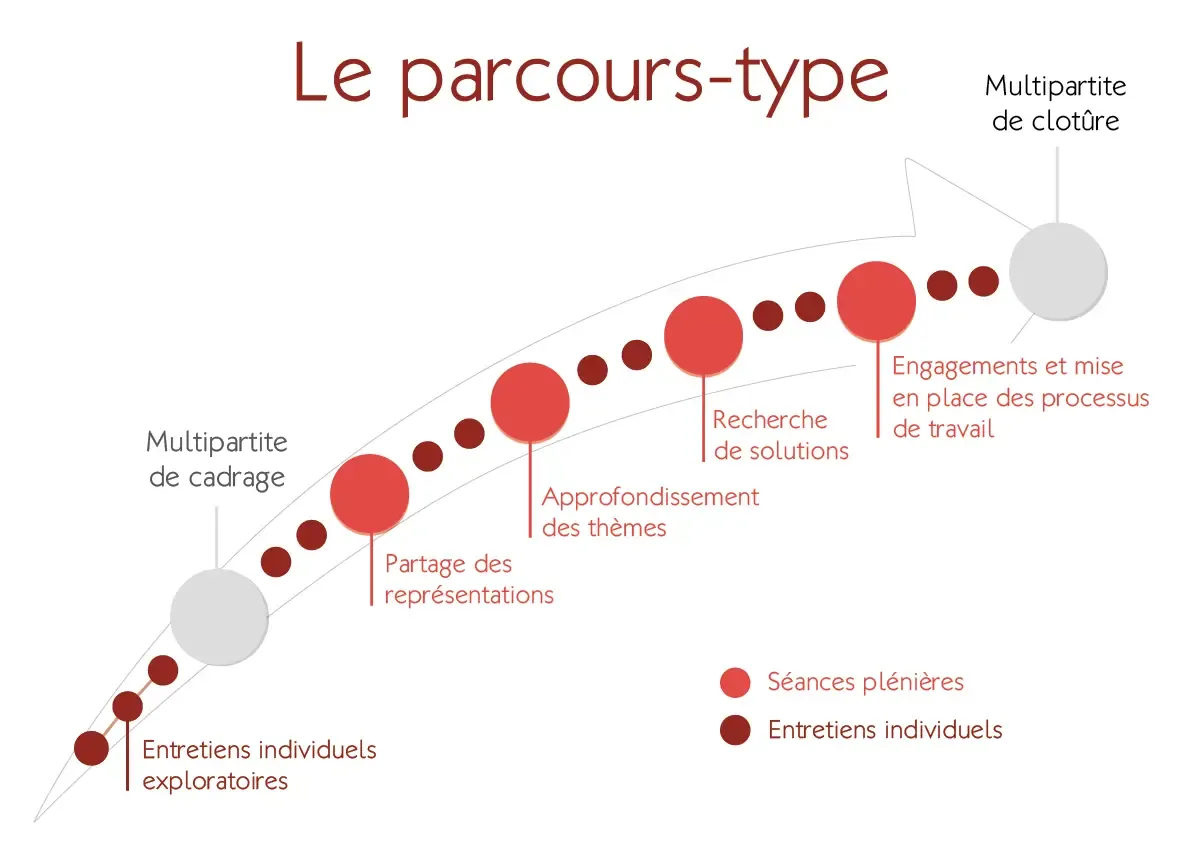
A final meeting, with HR and/or line managers, reviews the process, evaluates the progress made and considers the next steps to maintain a healthy working relationship.

The typical mediation journey

Case studies

Pierre and Nathalie no longer speak to each other

Pierre heads a department in a large French group and Nathalie is his senior team member, an expert in her field. They have worked together for several years, but the relationship has kept deteriorating to the point where they no longer speak to each other.

Their lack of communication blocks the files going through the department, and people complain about how hard it is to work with them.

Pierre's manager suggests mediation coaching and, should it fail, considers moving one or the other, or even both.

The plenary sessions first let them voice the many unspoken grievances that had built up and restore a beginning of trust, each understanding that the other is not doing it "on purpose".

They then discuss their personal ways of working and realise their preferences are diametrically opposed. Here too, the exercise contributes to better mutual understanding.

Finally, they define their working rules together: expected reporting, handling of files, running joint meetings, handovers.

At the end of the process, while they have not become best friends (which is not the goal), they have found an effective working relationship to accomplish their mission.

Arthur and Thomas want to end their partnership

Arthur and Thomas started a company together 10 years ago. In recent years they went through difficulties that damaged the relationship. Arthur no longer wants to continue the adventure.

They tried to discuss the terms of their separation together, but it ended in endless email exchanges where they misunderstand and irritate each other.

Thomas has the idea of turning to mediation coaching to help them think through the separation together.

The plenary sessions first let them talk about the reasons for wanting to separate and the resentments that have built up.

The one-to-one work lets Thomas grieve the partnership with Arthur, and Arthur clarify what he wants to build (rather than just "separating").

Back in plenary, they have a framework to consider every hypothesis and option (including not separating), analyse these options and set out the valuation elements on which they can make each other proposals.